Tilda is one of the most popular website builders in Kazakhstan: sites come together quickly and look good. So we hear “why not Tilda?” on almost every call.
We build stores on Shopify, but to be honest: Tilda is a good tool. It’s just built for a different job. It all comes down to what you’re building — a page or a store.
In short: Tilda is for a landing page and a small catalogue without complex stock tracking. Shopify is for when the store becomes a business: a catalogue, stock, orders every day, several sales channels.
Where Tilda is strong
- Design and landing pages. Ready-made blocks and a free-form editor let you build a beautiful page without a developer.
- Price. A Tilda subscription costs less than Shopify.
- Quick start. A page with an enquiry form can go live in an evening.
Tilda has a store too: a product catalogue, cart and payments. According to Tilda’s help, the Business plan allows up to 50,000 products in the catalogue. In practice, though, Tilda is mostly chosen for catalogues of dozens or hundreds of items — beyond that, working with orders and stock gets awkward.
Where Shopify is stronger
- Orders. Statuses, full and partial refunds, each customer’s history, payment and delivery marks. All in one admin, on your phone too.
- Stock. Tracking for every size and colour, several locations, automatic deduction when an order comes in.
- Apps. The Shopify App Store has thousands of apps: reviews, promotions, shipping, analytics. A feature you need usually installs in minutes instead of being built from scratch.
- Languages and currencies. Kazakh, Russian and English versions in one store, without copying pages.
- Reliability. Hosting, security, traffic spikes and updates are on Shopify’s side.
- Sales channels. You can connect Kaspi orders, Kaspi Pay and other marketplaces to Shopify and run everything in one place.
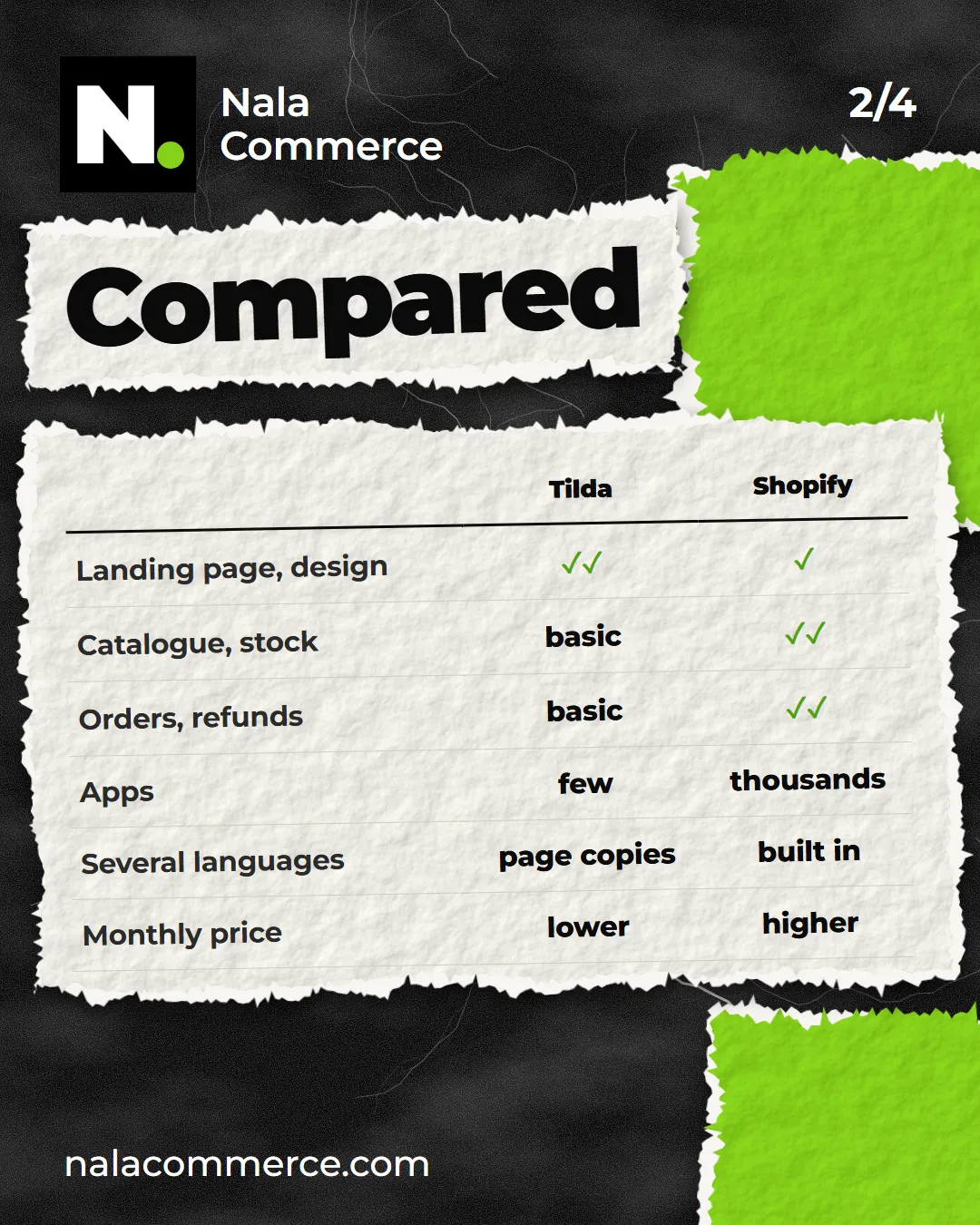
Point by point
- Landing page and design. Tilda — stronger; Shopify — good, through themes.
- Catalogue and stock. Tilda — basic; Shopify — full.
- Orders and refunds. Tilda — basic; Shopify — full.
- Apps. Tilda — few; Shopify — thousands.
- Several languages. Tilda — page copies; Shopify — built in.
- Monthly price. Tilda — lower; Shopify — higher.
When to choose which
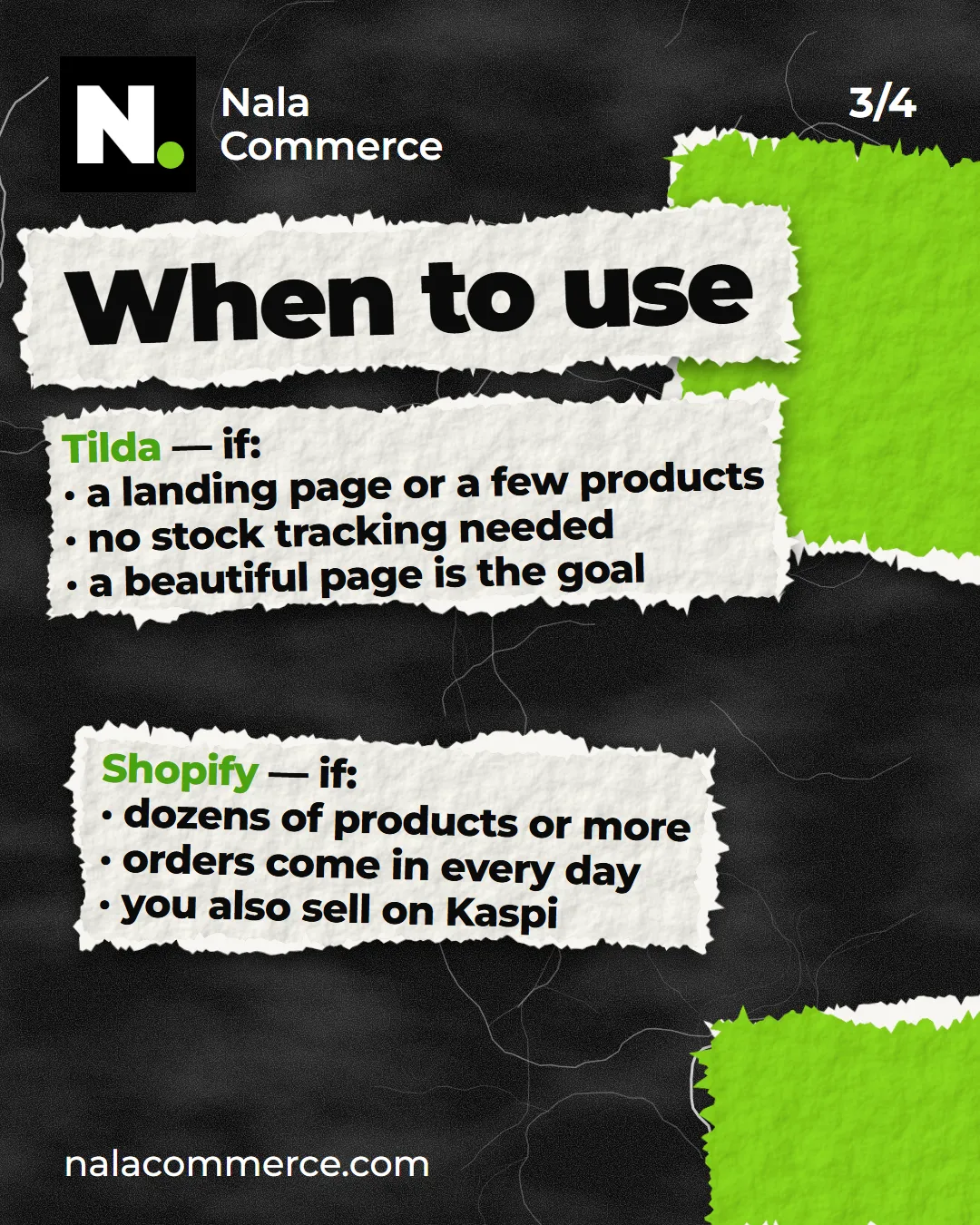
Tilda fits if:
- you need a landing page, a brand page or a few products;
- you don’t need stock tracking — items are made to order or there’s plenty;
- the goal is a beautiful page and enquiries, not a stream of orders.
Shopify fits if:
- your catalogue has dozens or hundreds of products in sizes and colours;
- orders come in every day and need handling without chaos;
- you also sell on Kaspi or marketplaces and want to see everything in one place;
- you plan to grow — add languages, locations and sales channels.
What about money
Tilda’s subscription is cheaper — that’s true. But count time, not just the subscription. If a manager reconciles orders and stock by hand every day, the price difference goes on paying for that work — and on mistakes when you sell something that’s already gone.
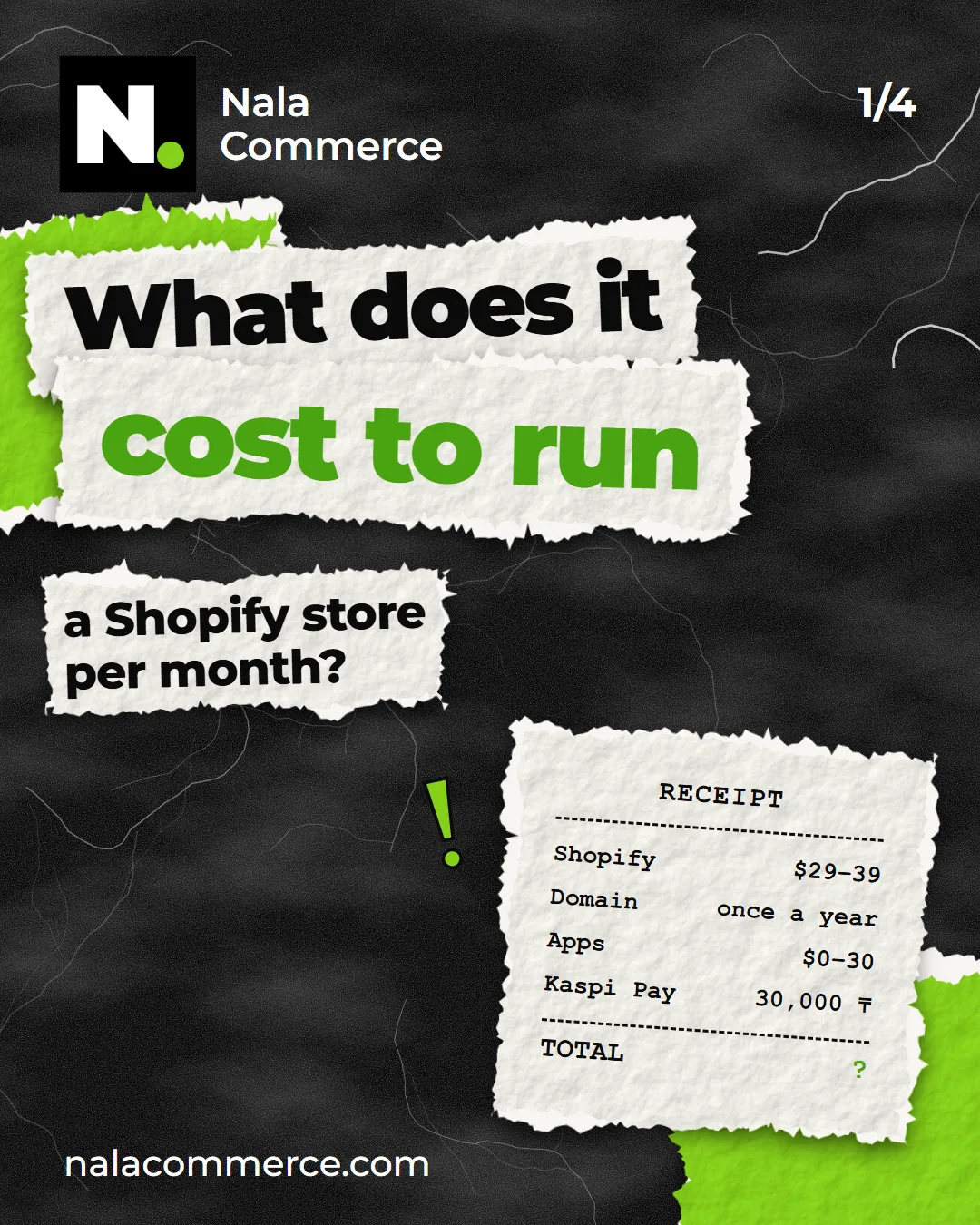
What Shopify costs per month — with plans, apps and payments — is in “How much does a Shopify store cost to run”.
Already on Tilda?
Moving doesn’t mean starting over. We move products and pages and redirect old links to the new ones — so shoppers coming from Google and bookmarks don’t land on an empty page.
Tell us what you have on Tilda now and how many products — we’ll quote the move. And if it turns out Tilda is still enough for you, we’ll say so.